Trump's oil price fake
US crude export fell under President Biden by 40%, most probably due to decrease in
demand by foreign partners. This is logically leading to a decrease of the crude price.
Even though reasons for a lower consumption are mainly positioned abroad, further
impact of erratic & invasive US politics under the following Trump administration can
be expected.
As global crude prices are usually hovering near 100 $ per barrel, it is not surprising
that such prices had been slightly higher under the predictable rule of Obama & Biden,
but didn't pose much of a problem for US consumers while the overall economy was
running more quietly without Trump.
However, after the US war on Iran started under president Trump, that decrease in
demand of US oil has even reached 50%. Since the blockade of Hormuz and some
military disturbances effecting Saudi oil production, its transportation via pipeline &
Red Sea shipping, an additional factor heavily influenced global prices for crude oil:
Increasing shipping costs that are distorting the market, and which are differing
according to the length of shipping routes. For that I prepared another separate
information link.
From there, any decrease of crude oil prices cannot be
necessarily related to the genius of US president Trump.
As geopolitics still matter, it is clear that all kinds of erupting military conflicts
and other political disturbances like trade wars are leaving their imprint on the
history of crude price development. From time to time, oil extracting countries,
united in the OPEC organisation, have to intervene by cutting their production
quotes in order to stabilize global crude price:

|
|
Last week now, Trump declared his will to partly
abandon sanctions on Russia, allowing Putin to
sell giant amounts of diesel fuel on the global
market. This happened only shortly after urging
European nations to melt down part of their
strategic reserves, and which was seen as a
kind of blackmail by US partners in the EU.
This was obviously intended to ease fuel prices
for his voters in rural areas of the USA that had
already been badly treated by some Chinese
retaliatory tariffs on certain agricultural
products.
Only days before Trump's Midterm Elections, it
became clear that Trump is forced to abandon
sanctions much earlier agreed between the USA
and their European partners. It is as if he finally
recognized the failure of his own unpredictable
way of managing the complex problems of his
country.
Trump's political bankruptcy is
therefore as well a moral one.
As to the wealth his questionable helpers
aquired for him during his presidency, he
won't be able to enjoy it as an incompetent
inventor of facts showing first signs of a
premature dementia.
|
China's lever on US soybean export
Soybeans are one of US biggest agricultural exports, and China is the most
important buyer. The US exported $16.5 billion worth of soybeans last year,
making soybeans the second-largest agricultural export after corn, according
to the US Department of Agriculture. China buys more soybeans than every
other country because it has limited arable land.
That dependence has made soybeans vulnerable to swings in US-China trade
policy. In the years before the first Trump trade war in 2018, America's Soybean
Association estimated 28% of all US soybean production was shipped to China.
When Beijing then imposed a 25% retaliatory tariff on US soybeans in 2018, the
US Department of Agriculture (USDA) estimated farmers absorbed $9.4 billion in
soybean losses, costing Iowa $1.2 billion and Illinois $1.3 billion.
That helps explain why Trump focused on soybeans in his dealmaking with
Beijing. In November, he struck a deal with Xi under which China committed
to buying at least 25 million metric tons of soybeans in 2026, 2027, and 2028.
After he met Xi in May, the first time a US president visited China since 2017,
the White House announced China agreed to buy at least $17 billion in agri-
cultural products on top of those prior soybean commitments.
But China has options ...
For all of soybeans importance to American farmers, China has a 2nd supplier:
Brazil, a member of the China led commercial alliance of nations BRICS.
Brazil had already overtaken the US as China s largest soybean supplier over
a decade ago, but recent trade tensions have widened the gap. USDA said
that 71% of China s soybean imports came from Brazil, and its agricultural
attaché in Beijing reported last year that Brazil s share had continued to grow
at the expense of the United States which was helped by cheaper prices.
So China left the door half-closed. [Fortune, September 28, 2026]
|
Donald - Who are You ?
Who are Your Friends ?
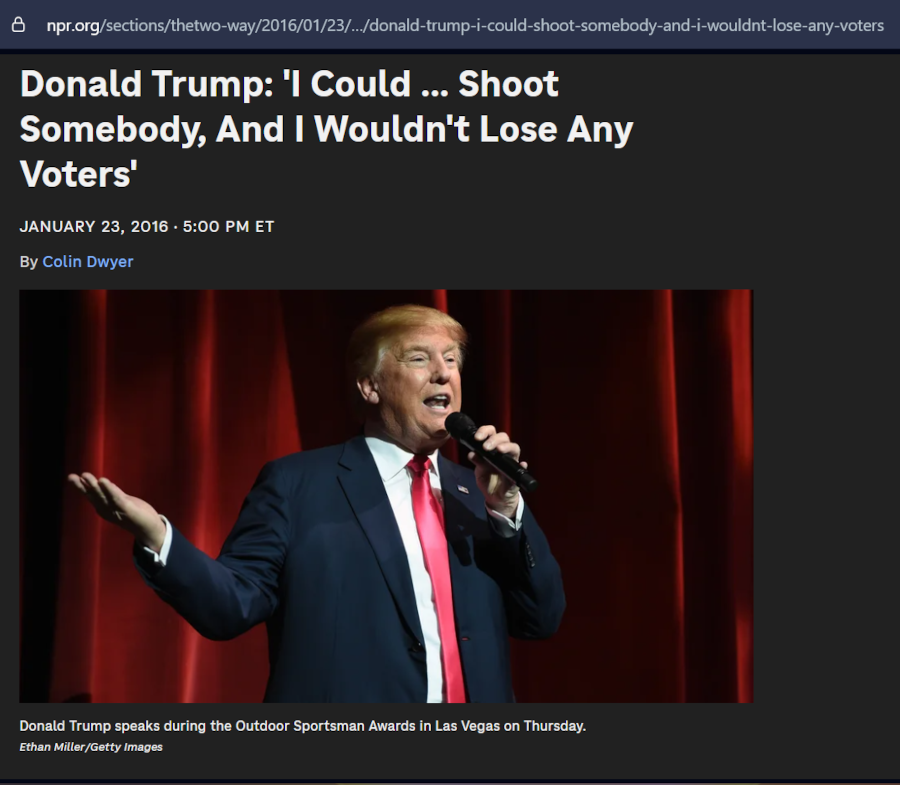
"I could stand in the middle of Fifth Avenue and
shoot somebody, and I wouldn't lose any voters"
Trump remarked in January 2016 at a campaign
stop at Dordt College in Sioux Center, Iowa.
Grabber King Climbing
Chikago Trump Tower

The Epstein Connection
Click to the Picture
and get to the facts
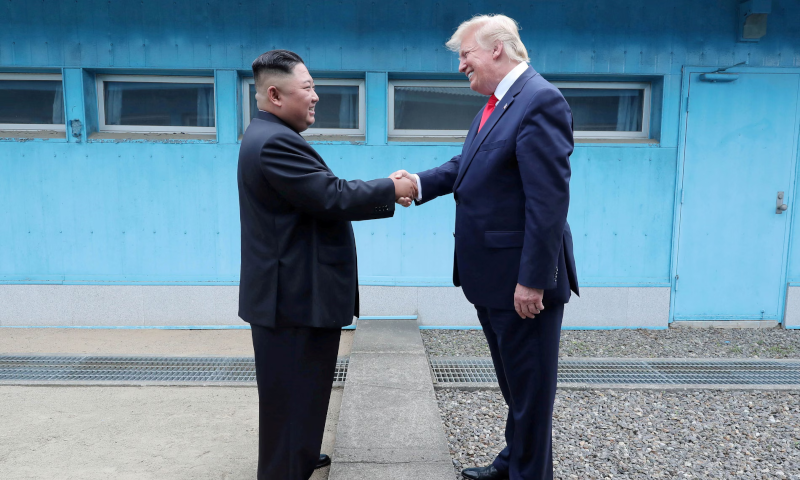
Trump meets with N Korean leader Kim Jong-un at
the DMZ on the border of North & South Korea in
June 2019.
In 2026, Kim is already deeply involved in military
support for his strategic partner Putin who is now
terrorizing Ukrainian civilians on a daily basis and
therefore creating problems for Trump's European
NATO partners.
He craved for playing with the Big Boys
... but these guys are more experienced.
|